The New Front Line of Patient Advocacy: PDABs and the Trouble with QALYs

If you live with CRPS, you are likely an expert at navigating pharmacy counters and insurance appeals. But there is a new acronym in the healthcare landscape that might determine whether you can access your medication at all: PDABs.

Combined with a controversial metric called the QALY, these boards are changing the way the value of your life—and your relief—is calculated.

What is a PDAB?

Prescription Drug Affordability Board (PDAB) is a state-level body created to curb rising drug costs. Think of them as a “watchdog” for medication pricing. They review specific high-cost drugs and, in some cases, can set “upper payment limits” (price caps).

While the goal of making medicine cheaper is noble, the method they use to decide if a drug is “worth it” is where the chronic pain community faces a significant risk.

The QALY: Measuring the “Quality” of Your Life

To decide if a drug is “cost-effective,” many boards rely on a metric called the Quality-Adjusted Life Year (QALY).

  • 1.0 QALY represents one year of “perfect health.”
  • 0.0 QALY represents death.

If a patient is living with a disability or chronic pain, the QALY system assigns their life a value less than 1.0.

The Problem: When a PDAB uses QALYs to determine if a pain medication is “worth the price,” the math is inherently biased. Because the system views a year of life with chronic pain as “lesser” than a year of life in perfect health, the “value” of a treatment that extends or improves that life is mathematically downgraded.

Why Chronic Pain Patients Should Be Concerned

Restricted Access: If a PDAB decides a drug isn’t “cost-effective” based on QALY math, insurance companies may stop covering it or move it to a “specialty tier” with massive co-pays.

Discrimination by Algorithm: Using QALYs can lead to “value-based” decisions that discriminate against the elderly and those with permanent disabilities. It suggests that a treatment for someone who will never reach “perfect health” isn’t as worth the investment.

Ignoring the “Patient Voice”: Metrics like QALYs often fail to capture the nuances of chronic pain, such as the ability to return to work, attend a child’s graduation, or simply experience a 20% reduction in daily agony.

What Can You Do?

The good news is that several states and federal advocates are fighting to ban the use of QALYs in drug evaluations, arguing that they violate the Americans with Disabilities Act (ADA).

Self-Advocate: If your state has a PDAB, find out when their public comment periods are. As of late 2025, the following states had PDABs: Colorado, Maine, Maryland, Massachusetts, Minnesota, New Hampshire, New Jersey, New York, Ohio, Oregon, and Washington. If your state has a PDAB, you can click here for updates.

Share Your Story: Data points don’t feel pain, but people do. Telling a board how a specific “expensive” medication allowed you to function can humanize the cold math of a QALY.

Support “Quality-Neutral” Metrics: Push for boards to use alternative measures that don’t discount the value of life based on disability status.

Your life is a 1.0, regardless of your pain score. Don’t let a PDAB tell you otherwise.

Lisa Van Allen, MS, PhD is a Pain Psychologist and the Chair of the RSDSA Advisory Board. When she’s not writing for the RSDSA or her own blog, you will find her trying to keep her pups out of the fresh paint on her canvases. 
Tonko, Miller-Meeks Introduce Resolution on Complex Regional Pain Syndrome/Reflex Sympathetic Dystrophy Awareness Month

Bipartisan resolution recognizes rare, painful condition

WASHINGTON, DC—Representatives Paul D. Tonko (D-NY) and Representative Mariannette Miller-Meeks (R-IA) today announced the introduction of a bipartisan resolution designating November as Complex Regional Pain Syndrome/Reflex Sympathetic Dystrophy Awareness Month to raise awareness about this rare neuro-inflammatory syndrome and ensure individuals living with this condition have access to early detection as well as safe and effective treatments.

Complex Regional Pain Syndrome also known as Reflex Sympathetic Dystrophy is characterized by persistent, regional pain that is disproportionate to any known trauma or lesion, and is accompanied by sensory, motor, vasomotor, and/or trophic changes in the affected limb.

Rep. Tonko successfully championed the push in Congress to improve visibility and access to treatments for the millions of individuals impacted by a rare disease with his Helping Experts Accelerate Rare Treatments (HEART) Act, which was signed into law in December 2022.

“For the millions of Americans living with a rare or ultra-rare disease, reliable information is scarce and treatment options are even more limited, leaving patients and their families with few paths forward and even fewer reasons for hope.” Rep. Tonko said. “That’s why I am incredibly proud of my work alongside advocates to have passed the HEART Act. This law amplifies the voices of those living with a rare disease as well as healthcare professional who care for them, while also accelerating the development and approval of new treatments. But my work to uplift the needs of those living with these rare conditions is far from over. Today, I’m honored to introduce a new resolution on Complex Regional Pain Syndrome alongside Representative Miller-Meeks and am deeply grateful to all those who have helped raise awareness on this often-overlooked condition. I pledge to continue working to ensure Congress meets the needs of those living with a rare disease.”

“As a physician, I know how devastating Complex Regional Pain Syndrome can be for patients who often spend years searching for answers,” Rep. Miller-Meeks said. “Early detection and access to effective treatment are critical, yet too many Americans face delays, misdiagnosis, or a lack of awareness. I’m proud to join Rep. Tonko in leading this bipartisan effort to shine a light on CRPS and ensure that patients, families, and providers have the tools and support they need.”

The text of the resolution can be viewed HERE.

In a statement, the Reflex Sympathetic Dystrophy Syndrome Association (RSDSA) said, “Reflex Sympathetic Dystrophy Syndrome Association (RSDS.org) supports CRPS Awareness as a great step forward in giving comfort and hope to all those afflicted with CRPS. We are deeply grateful to Representative Tonko and Representative Miller-Meeks for their continued commitment to raising awareness. The nature, and even the existence of CRPS, is too little known. Increasing awareness of CRPS will motivate wider education about this painful disease among healthcare professionals as well as among the lay public. It will promote support for those who suffer with CRPS, and it will encourage research into the mechanisms of the disease of CRPS, which will lead to better treatments, and, ultimately, for a cure for CRPS.”

September is Pain Awareness Month!

by Lisa Van Allen, PhD, Chair of RSDSA’s Advocacy Committee

Throughout the month of September, RSDSA will participate in the US Pain Foundation’s #ThisIsPain awareness campaign on social media and we invite you to join us! Here are seven ways to raise awareness about chronic pain and CRPS:

Spread Awareness: U.S. Pain Foundation will share #ThisIsPain statistics and graphics on their social media channels each day. Consider sharing those on your social media channels and tell the story of how this neuro-inflammatory syndrome regularly impacts your pain. Help both organizations amplify the voices behind the numbers!

Tell Your Story: Submit an op-ed to your local news outlet—or send it to U.S. Pain and RSDSA. Please note that select stories may be featured on the U.S. Pain and/or RSDSA website and social platforms to spotlight lived experience.

Read & Share Weekly Articles: Each week, U.S. Pain will publish a new article highlighting key findings from their national survey. Consider sharing them to spark awareness and conversation!

Explore and Provide Data: Review U.S. Pain’s survey findings to understand the scope of pain in America and also consider taking RSDSA’s community survey so we can better understand what the CRPS community wants to see and hear from us.

Build Community: Join one of RSDSA support groups. We recently updated our support group list to ensure we are providing the most updated information to the community.

Advocate for Change: Contact your elected officials about policies affecting pain care. Share data with your congressional representatives and ask them to support funding for pain research.

Validate Someone’s Pain: Sometimes the most powerful action is simply listening. Reach out and remind someone with CRPS that they are seen, heard, and believed.

As you post on social media, be sure to use the hashtags #ThisIsPain along with #CRPS.

Advocacy Pays Off

by Lisa Van Allen, PhD, Chair of RSDSA’s Advocacy Committee

RSDSA sent out an alert asking you to contact your Congressional representatives to voice your support for increased funding of the NIH for research on rare diseases. During the week of August 11, I had virtual meetings with Senator Chuck Grassley, Senator Jodi Ernst, and Rep. Ashley Hinson. I also sent letters to senators working on the budget committee. Each of the staff members I talked with listened, asked great questions, and expressed their support. This was my second meeting with Sen. Grassley this year and he remembered our conversation during Rare Disease Week in February. This was impressive simply due to the huge number of people he talks to every day as he serves as Senate Pro Tempore, chair of the judiciary committee, and on the budget and finance committees. But he was moved by my story and acknowledged the need for continued research of rare diseases, including CRPS.

It is easy to be awed or intimidated by people serving in Congress, but we must remember two things: 1) they are human with all the strengths and deficits people have, and 2) they chose to accept a position that serves their constituents.

When you contact your representatives, keep this in mind. Appeal to their humanity. They don’t know CRPS pain, but they live with or know someone who lives with chronic pain. Remind them that you are watching their voting records. Mention votes you approve of, or encourage them to reconsider their position on an issue. You will find this blend of appealing to their humanity and respectfully holding them accountable for their actions will have them listening and engaging with your request. 

I am very happy to report that I have learned that our advocacy efforts are working. Funding levels for the NIH have been continued with an increase of $400 million dollars for the end of FY2025. I have been assured by the senators and representatives I contacted that they will keep our request for improved funding of rare disease research in mind as they consider the FY2026 budget. 

If you have not yet contacted your Congressional representatives, it is not too late! An email, letter or phone call takes very little time, but can make a big difference. We need as many of you participating as possible! Contact forms are available on most Senator and Representative web pages, so first identify your Congressional representatives via Congress.gov and then fill out the contact form on their web page. On the contact form, briefly share what living with CRPS is like, and then ask support for increased funding for rare disease research. When you’re done, you’ll have the joy of knowing you’ve made a difference! Let us know when you hear back from your representative as it will help me as I continue to advocate on behalf of RSDSA. 

Self Advocacy: When It Feels Like It’s All Too Much

By Lisa Van Allen, Chair for RSDSA’s Advocacy Committee

I was recently listening to one of my favorite podcasts, Hidden Brain hosted by Shankar Vedantam, where the guest was talking about her research into how people respond to overwhelming challenges. In the episode, “When It’s All Too Much,” Sarah Jaquette Ray describes how she found her students were overwhelmed by the problems in today’s world to the point of nihilism, deep depression and in some cases suicide. It was not a leap to compare these students to people living with Complex Regional Pain Syndrome, nicknamed “The Suicide Disease.”

Living with unrelenting pain can drive you to feel that life is meaningless. There are many losses on this journey of pain – mobility, career, relationships, and especially the image you had in your mind of what your life was going to be. Those losses chip away at your sense of self and the things that bring you joy. Surviving and thriving in the face of this darkness is not easy. It requires choosing hope and intentionally lining up activities that give you a sense of meaning and purpose. 

Sarah Jaquette Ray spoke about several things that she believes can combat this nihilism. I believe these techniques will work to offset the deep suffering that comes with CRPS.

→ Being part of a community rather than trying to face overwhelm alone is essential. Isolation is a normal response to feelings of grief and depression, but it is not a solution. Sharing your fears and griefs with others lightens the load. But make sure this group focuses mainly on hope. If you’ve ever been in a Facebook group where everyone is describing how awful their symptoms are, you know just how contagious darkness and depression can be. That doesn’t mean you have to be a ‘Pollyanna’ and only express positive thoughts. Just be sure to surround yourself with people who know how to encourage and support you.

→ Focusing on beauty in spite of the ugliness in the world. We live in a world filled with extraordinary beauty, but we tend to spend more time on destructive, ugly things coming at us from our phones, TVs and other media. It is survival, not escapism, to turn off the news and turn on NatGeo or Discovery.

→ Learning to hold joy and suffering at the same time requires emotional maturity. All or nothing, black and white thinking limits your capacity to cultivate joy and purpose. Simply holding out your hands and imagining that you are simultaneously holding joy in one and suffering in the other opens a window of opportunity in your mind. Yes, I am in pain – And I am enjoying this moment because I am ___________. How would you fill in the blank? For me it might be holding my puppy, or painting a picture, or sitting on my deck with the sun on my face.

→ Finding small ways to reduce the pain. I can’t completely eliminate my pain, but I can find little things that make it better. Soaking in scented epsom salts and then spraying on a moisturizer makes my CRPS affected foot look and feel a little better. Mindfulness meditation is not a cure, but even five minutes of mindfulness and relaxed breathing reduces the stress that builds from constant pain. Getting a massage on non-affected areas helps reduce stress and tension as well.

→ Building up your spirituality and/or faith. Research has demonstrated over and over that meditation and prayer reduces pain and helps with healing. Belief in a Power greater than yourself and your problems can bring great comfort.

→ Spending time in purposeful activities helps you feel better about yourself and combat those feelings of worthlessness. Write a letter to your congressman about legislation that would make life better. Write an article for the RSDSA blog or your newspaper. Join a support group and share your story. Participate in the RSDSA Virtual Walk and raise funds that make a difference. There are all kinds of ways you can make life better for yourself and everyone living with CRPS.

Depression can be a serious disease. If you find yourself struggling with feelings of sadness, grief, loss, and or meaninglessness that last more than a few days and lead to pervasive thoughts of harming yourself, please get help. Contact your medical provider or a mental health professional. You might find that treatment of your depression might help with your pain, as medications used for depression and anxiety have been proven to help with pain management. Instead of allowing darkness to overwhelm, choose to create a life of meaning and joy.


If you’re ever in need of help, please call the National Suicide Prevention Lifeline by dialing 988. You can also send a text to the Crisis Text Line by texting the word HOPELINE to 741741

Pharmacy Benefit Managers and the DRUG Act

Written by Lisa Van Allen, Chair of the RSDSA Advocacy Committee, for the RSDSA blog.

I was recently asked for input on new legislation introduced by Rep. Marianette Miller-Meeks and five of her colleagues: Reps. Nannette Barragan (D-CA), Nicole Malliotakis (R-NY), Brad Schneider (D-IL), Rick Allen (R-GA), and Donald Norcross (D-NJ). The DRUG Act, or Delinking Revenue from Unfair Gouging Act, is a bipartisan bill that would rein in Pharmacy Benefit Managers (PBMs) requiring them to only charge a flat fee for drug placement versus letting them continue to charge a percentage of the drug price.

My response was a big YES – I support this bill and think you will want to as well. Here’s why:

The current structure in most pharmacies incentivizes PBMs to promote higher-priced medicine that takes money away from patients. PBMs are third-party administrators that manage prescription drug benefits for employers, health insurers, and other clients. They negotiate drug prices, process claims, and provide services such as drug rebates, disease management, and medication adherence programs. PBMs contribute to high drug costs because they are incentivized to steer patients towards drugs that are more profitable for PBMs, but may be less clinically effective for consumers. This broken system disproportionately harms low-income individuals, seniors, and those with chronic illnesses who rely on life-saving prescriptions to manage their health.

One of the challenges in demanding greater accountability from PBMs is the relative lack of information about how they operate. The drug pricing process overall is already opaque, and PBMs add another layer of secrecy. Most insurers contract with PBMs to handle the administrative side of their drug benefit provision. But PBMs have no obligation to share details with insurers about how the PBM determines formulary placements, why some drugs in the formulary are more costly than others, and what proportion of the rebates and negotiated drug payments PBMs keep. This presents a challenge for insurers, plan sponsors, and for patients who end up bearing the cost of medications they desperately need.

PBMs are a growing faction in the distribution and payment ecosystem for prescription medicines. As the entity between pharmaceutical companies and pharmacies, PBMs initially played a key role in reducing prescription medicine costs and increasing access and affordability for Americans. Unfortunately, PBMs have grown and vertically integrated to the point where the three largest PBMs control over 80% of prescriptions, up from 30% in 2010. There are six PBMs that make up most of the market: CVS (Caremark), Cigna (Express Scripts/Evernorth), UHC (OptumRx), Humana (Pharmacy Solutions), Magellan (Prime Therapeutics), and MedImpact Healthcare Systems. Their modern-day practices of driving up list prices to extract higher rebates for formulary placement are occurring at the expense of patients in the form of higher insurance premiums and higher prescription drug costs.

PBMs often bill patients more than what they pay to the pharmacy for medicines and keep the difference, enriching themselves instead of the patients they are supposed to benefit. This business practice, known as spread pricing, adds opacity to a supply chain that needs transparency. PBMs have attempted to rebrand spread pricing, calling it “risk mitigation pricing,” and contending that it provides predictability for plan sponsors and lowers drug cost. what spread pricing actually does is drive up costs without any accountability or explanation to the consumer.

Please write to your US Representative and ask them to support H.R. 6283, the DRUG Act, and start Delinking Revenue from Unfair Gouging.

You can find your representatives here.

Be sure to let me know what you think of the Drug Act. Do you have a story to share? We want to hear it!

March 2025 Legislative Update: Support the EXPERT Act

Written by Lisa Van Allen, Chair of the RSDSA Advocacy Committee, for the RSDSA blog.

Representatives Doris Matsui (D-CA) and Gus Bilirakis (R-FL) and Senators Amy Klobuchar (D-MN) and Roger Wicker (R-MS), co-chairs of the Rare Disease Congressional Caucus, reintroduced the Scientific External Process for Educated Review of Therapeutics (EXPERT) Act, which seeks to formalize the Externally-Led Scientific-Focused Drug Development (EL-SFDD) meeting at the Food and Drug Administration (FDA).

This legislation seeks to bridge the gap between rare disease expertise and regulatory expertise through the EL-SFDD. These quarterly meetings will provide an opportunity for enhanced collaboration between medical experts, drug sponsors, scientific organizations, and patient advocates to discuss the challenges impacting the development of rare disease treatments, identify scientific opportunities to facilitate development, discuss novel clinical trial designs, and align on endpoints to address unmet medical needs for rare disease patients. Each meeting will focus on a different rare disease topic, and the FDA will report annually on how these sessions are helping to shape and improve its internal review process for rare diseases. 

In layman’s terms, this would put researchers in the same room with patients and funders to work together toward shortening the timeline on the creation of drugs that treat rare diseases like CRPS.

For more on this bill, click here

Contact your legislators today and ask them to support the EXPERT Act.

When you contact your congressional representatives, be sure to also ask them to support funding for Medicare/Medicaid and FDA research. Budget cuts are coming and we need to remind our representatives just how important healthcare services and research are to us. If you have a specific story about how Medicare or Medicaid covers treatment you need, be sure to include it. And then share your letter with us – we want to hear your stories and have examples to share with others. 

Preparing to Talk With Legislators With a One-Pager

Written by Lisa Van Allen, Chair of the RSDSA Advocacy Committee, for the RSDSA blog.

Communicating directly with your legislator is the best way to promote change in the laws and policies affecting healthcare in the United States. When you meet with a legislator or staff member, preparation is important to assure your message is clearly and succinctly communicated. A “one-pager” is the best way to do this.

A “one pager” helps effectively deliver your message and facilitates a productive conversation on the issues of importance to you and your organization.

Meeting with a legislator or staff person in your local office or in the Capitol is a great way to share your CRPS story, information about your disease and/or organization, and problems that you and/or your organization face. We recommend creating a one pager to use as a tool during a meeting and to leave behind with the legislator or staffer at the end of the meeting.

A one pager is a brief fact sheet and should be one single page. When creating a one pager, present the information clearly and use concise bullet points.

Your one pager should include:

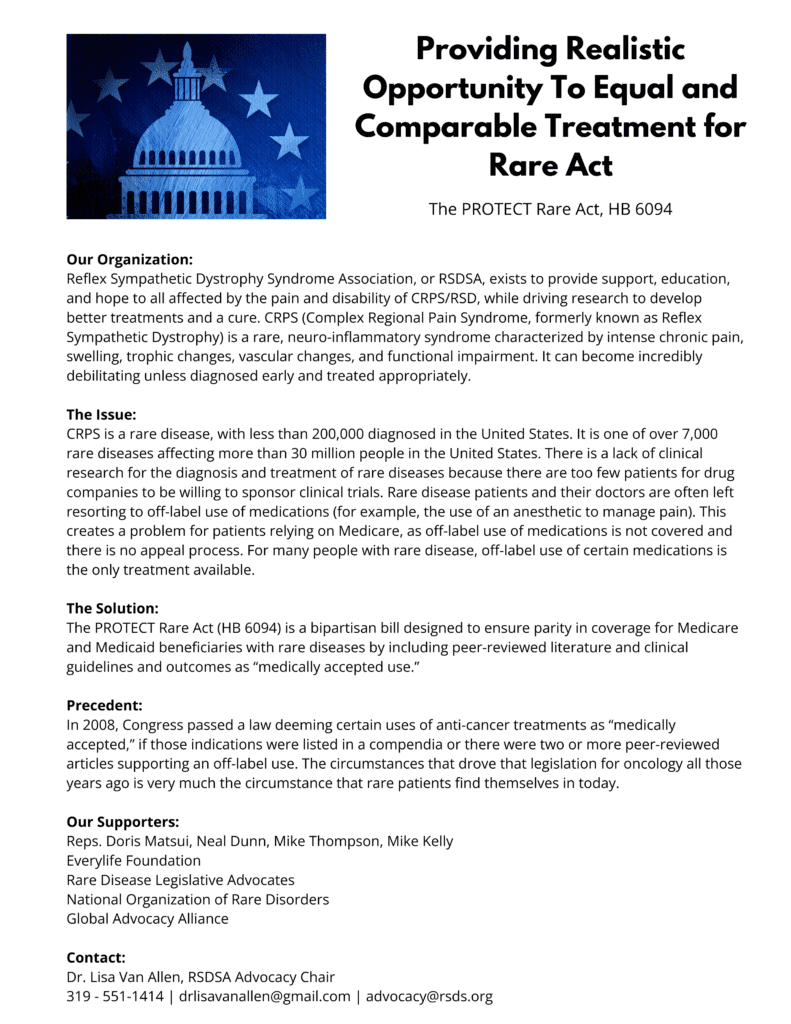
  • A brief statement on the organization you represent and what the organization does.
  • A brief summary of the problem that you are seeking help on. Use data and reference studies (when applicable) to support your position on the issue.
  • A brief summary of the solution to the problem, such as legislation, and what it will do for you and/or the pain community.
  • What your legislator can do to help, also known as the “Ask.” Example: Support the Protect Rare Act, HB 6094
  • Include a list of supporters such as a group of other organizations that support your position or piece of legislation, the co-sponsors of the legislation, and/or the other signers of the letter.
  • Include your contact information so that the legislator and staff person can contact you if they have any questions.

Creating your one-pager before your meeting with legislators is an excellent way to prepare and to create strong brief messages that will have an impact. 

Below you will see a sample one-pager on the PROTECT Rare Act. Do you have a one-pager that worked well in a meeting with a legislator? We’d love to hear about it! Contact the Advocacy committee at [email protected].

Cultivating Relationships with Your Representatives

Written by Lisa Van Allen, Chair of the RSDSA Advocacy Committee, for the RSDSA blog.

Building relationships with your Members of Congress is important to ensuring that CRPS patients are heard on Capitol Hill and policymakers are working to improve the lives of patients living with pain.

Members of Congress are more responsive to their constituents and more likely to support a policy proposal when they hear directly from people who live in their district. You can find contact information for your House Representatives and Senators here.

To build a relationship with your Member of Congress, you can:

  • Schedule a meeting with your Member in your local District office or on Capitol Hill
  • Get to know the key staff who handle health care policy in the district and in Washington, DC
  • Invite your Member of Congress or their staff to special events held in your community
  • Attend events like town halls that your Member of Congress holds in the district and state
  • Volunteer for a candidate’s campaign activities
  • Engage with legislators on social media
  • Write letters or emails to your legislators
  • Write op-eds for your local newspapers
  • Send “thank you” messages (call, email, letter, social media) when your legislators support rare disease issues

When should I engage with my Representative and Senators?

Anytime and all the time! Start out slowly, with one or two different activities. As issues arise, engage with your legislators on those issues. Pay attention to the issues you care about most.

As a bill progresses through Congress (committee, House vote, Senate vote, conference committee, etc.), let your legislators know about your position on the issue. Don’t wait until it’s too late to voice your support or concerns on legislation you care about.

How do I connect with my legislator?

  • Find personal connections you have in common! As a constituent, you are from the same state and area as your legislator. You may even live in the same neighborhood, go to the same school, etc.
  • There may be local products, places or activities your legislator loves – when appropriate, reference them in your correspondence (I.e., Sen. Grassley is passionate about cancer prevention, and Rep. Ashley Hinson has two young sons involved in sports).
  • Research the issues that are important to your legislator (check out their website, newsletter, and press releases).
  • Research legislation that the legislator has supported previously (check out their website and press releases).

TIP – Staff are an amazing resource and Members of Congress rely on them to advise them on issues that affect their district and constituents

This information was adapted from the Everylife Foundation.

Advocacy Update | House Bill 6094 Protect Rare

PROTECT Rare Act – Providing Realistic Opportunity To Equal and Comparable Treatment for Rare Act

Over 7,000 rare diseases affect more than 30 million people in the United States. CRPS is considered a rare disease as less than 200,000 people in the US are affected. There is a lack of clinical research for the diagnosis and treatment of rare diseases because there are too few patients for drug companies be willing or able to sponsor clinical trials. Rare disease patients are all too often left fighting for off-label access to a treatment. This creates an even larger problem for patients relying on Medicare, as Part D plans are prohibited from including off-label uses of medications in the formulary. For these patients, there is not even an appeal or reconsideration mechanism available to appeal.

The PROTECT Rare Act (HB 6094) is designed to ensure parity in coverage for Medicare and Medicaid beneficiaries with rare diseases by including peer-reviewed literature and clinical guidelines and outcomes as “medically accepted use”. There is precedent for using medications “off-book” as certain medications were deemed “medically acceptable” for cancer treatment in the 1970’s. For many people with rare disease, off-label use of certain medications are the only treatment available.

This bill is supported by more than 60 rare disease organizations, including the RSDSA.

We encourage you to contact your federal representatives and Senators and ask them to support the PROTECT Rare Act.